
Sword & State: Three Kingdoms — Chinese History Grand Strategy
Lead a faction through the politics and wars of late Han China, the Three Kingdoms and Western Jin. Sword & State: Three Kingdoms (兵國志:三國) is a browser grand strategy game for players who enjoy Chinese history, campaign maps and long-term decisions.
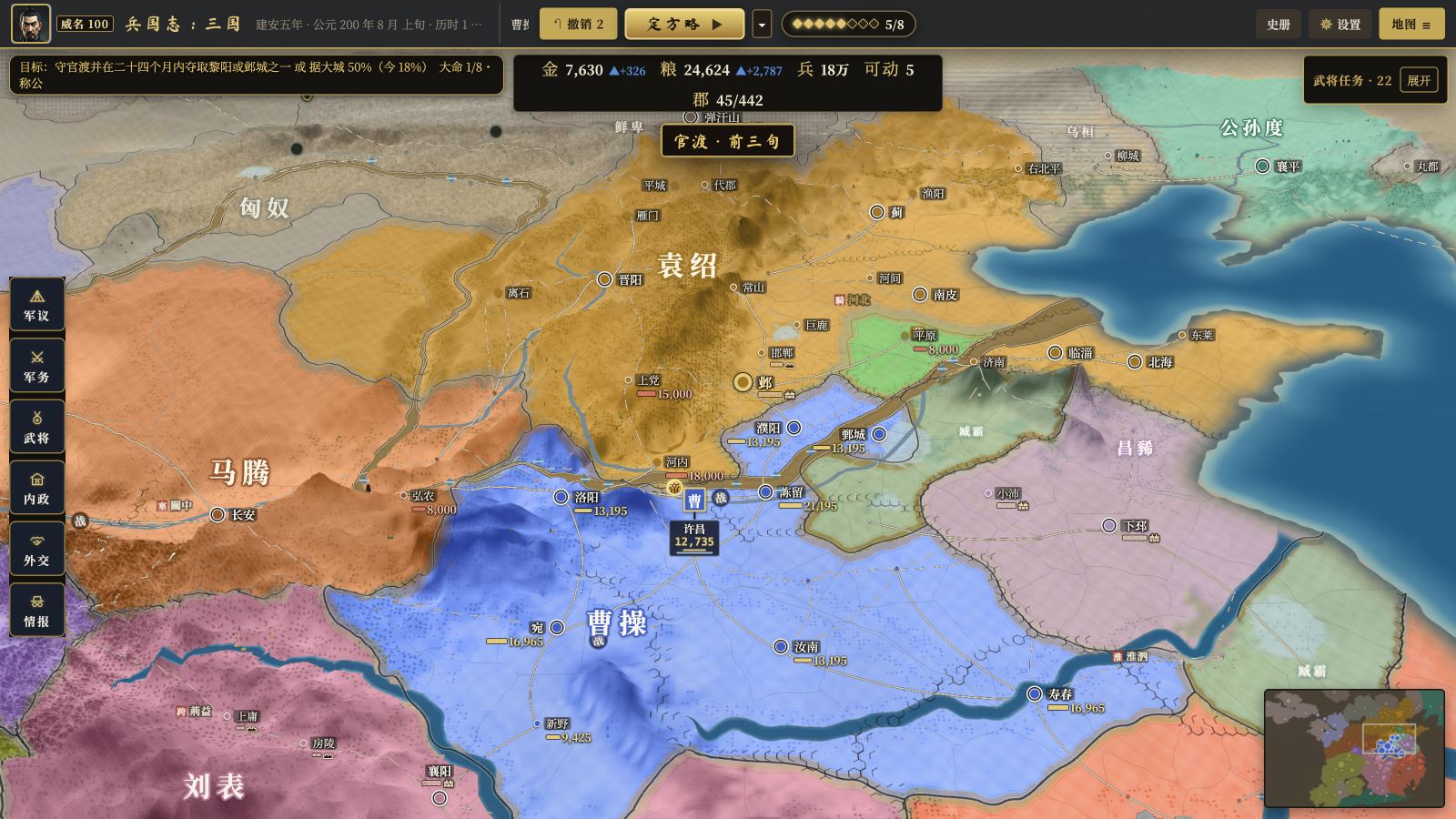
A campaign about more than army size
Manage cities and officers, plan marches and supply lines, negotiate with other factions and command tactical battles. Mountains, rivers and passes matter when choosing where to fight and how to support an army.
A map that gives your decisions a place
Main roads, mountain routes, passes and river crossings organize how armies can reach their targets. Owning an isolated city is different from holding its approaches and keeping a supply route open. A narrow corridor can be a valuable link, or a vulnerability.
Some combinations of cities and passes form strategic geographical positions, called xingsheng (形勝). Depending on the region and its requirements, these can support protected interiors, self-supply, mountain transport or river defense. Completing a region can therefore change what your faction can do.
Explore the map and warfare design (Chinese) →
Officers, cities and the decisions between battles
Officers have abilities, traits, personalities and biographies. Loyalty and privately held troops add questions of control to the choice of a capable commander. Meanwhile, city development supports income, food, soldiers, fortifications and talent: a campaign needs more than troops at the front.
Council proposals present choices with costs. Treaties and vassal relationships affect the wider balance of power, while six reputation paths connect your ruler’s standing to actions such as conquest, relief, recruitment, intrigue, aid and trade.
Selected historical events offer choices at turning points, subject to their scenario and trigger conditions. In the separate battle reenactment mode, a 3D tactical board lets you direct units, formations and tactics. Available encounters and controls depend on the selected mode.
Explore officers and rulership (Chinese) →
Scenario starts from 180 to 306 CE
The complete scenario library spans the late Han, Three Kingdoms and Western Jin eras, from the 180 CE scenario to the final phase of the War of the Eight Princes in 306 CE. These dates describe starting scenarios, rather than a requirement to play every campaign across the full period.
The current menu separates ten public beta scenarios from experimental scenarios that still need validation and balancing. Beta starts include the Yellow Turban Rebellion (184), Guandu (200), Red Cliffs (208) and the Three Kingdoms settlement (222). Read the Chinese scenario guide for the current list.
Who is this game for?
Try it if you enjoy Romance of the Three Kingdoms as a setting, Chinese political and military history, and grand strategy decisions involving territory, logistics, officers and diplomacy. The test build is best experienced on a desktop browser.
How to play
- Open the game and sign in with Google, or register with an email address and verify it.
- Choose a beta scenario, a faction and your preferred difficulty.
- Review your cities, officers, intelligence and supply routes before committing troops.
No game download is required. The current test and beta are free to try; final release pricing has not been announced. After signing in, your ten manual save slots and latest autosave sync to the Supabase cloud database, with a backup in your browser. Use the same account to access synced saves on another device. Older browser saves can be imported from the in-game cloud saves panel. Confirm that syncing has completed before clearing site data.
Languages and test status
The game offers Traditional Chinese, Simplified Chinese, English and Japanese language options. This overview is in English; the account flow, community and detailed guides are currently primarily in Chinese. The game remains in testing, so text, balance and available content may change.
For screenshots, see the gameplay showcase. For detailed mechanics, see the Chinese fog, vassal and retainer guide. Feedback can be posted on the official forum.
Contact us
For game information and general enquiries, email swordandstate@gmail.com.
Ready to lead a faction?
Sign in & try free ▶Google or verified email required. The sign-in screen is currently in Chinese.